
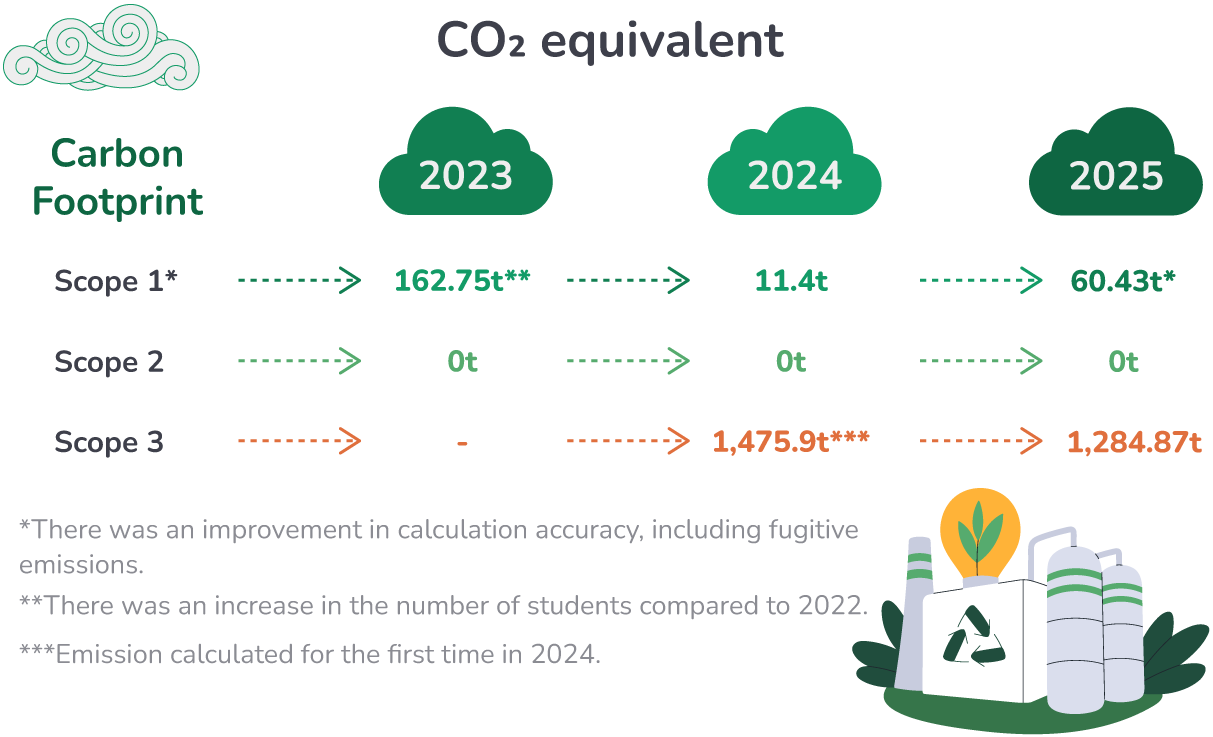
In 2025, we maintained our steady progress and refined our inventory calculations in accordance with the guidelines of the Greenhouse Gas Protocol (GHG Protocol), a leading international standard for quantifying and managing greenhouse gas emissions. As a result, we improved our calculations on fugitive emissions, which primarily stem from air-conditioning equipment and fire extinguisher recharging.
The carbon inventory is divided into three scopes:
Scope 1: Direct emission of greenhouse gas coming from sources controlled by the institution. In 2025, our direct emissions amounted to 60.43 metric tons of CO₂ equivalent, divided into:
Emissions from stationary combustion: 5.04 metric tons of CO₂ equivalent.
Emissions from mobile combustion¹: 3.9 metric tons of CO₂ equivalent.
Fugitive emissions²: 50.79 metric tons of CO₂ equivalent.
Emissions from organic waste composting³: 0.6 metric tons of CO₂ equivalent.

Scope 2: Indirect emissions related to the consumption of purchased electricity. In 2025, due to the use of clean and renewable energy, greenhouse gas (GHG) emissions from consumed electricity were zero.
Scope 3: Indirect emissions, which occur throughout UniFacens’ value chain. In 2025, emissions from these sources amounted to 1,284.87 metric tons of CO₂ equivalent.
Emissions from solid waste sent to landfills: 0.75 metric tons of CO₂ equivalent.
Emissions from domestic wastewater treatment¹: 71.1 metric tons of CO₂ equivalent.
Emissions from business travel²: 16.82 metric tons of CO₂ equivalent.
Emissions from private vehicles³: 1,196.2 metric tons of CO₂ equivalent.
In 2025, maintenance of our photovoltaic system continued at an accelerated pace, leveraging the key advancements made in previous years. Following an increase in generation capacity in 2024, we reached a new level: 15% of all electricity consumed in 2025 was selfgenerated by UniFacens.
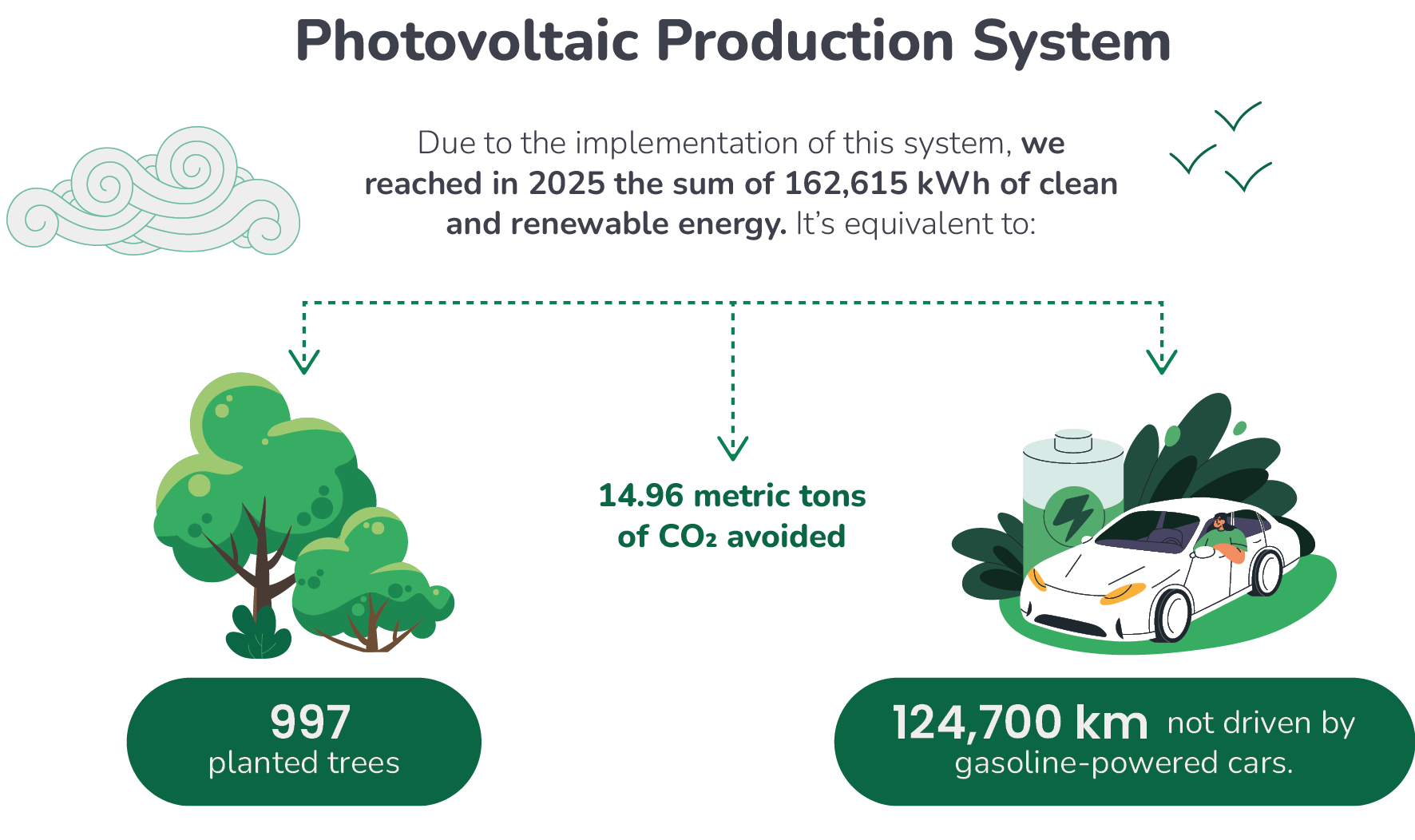
Despite the higher energy consumption registered last year, we maintain our internal policy of using 100% renewable energy.
We are part of the Free Contracting Environment (Ambiente de Contratação Livre - ACL), also known as Free Energy Market; as a result, we can procure energy exclusively from incentivized renewable sources — in other words, energy that comes from renewable sources.
In line with our commitment to full energy traceability, we work to ensure that the electricity we consume is certified through International Renewable Energy Certificates (I-REC). In 2025, we purchased 1,132 RECs, representing 1,132 MWh, a volume slightly lower than the 1,137 RECs purchased in 2024.